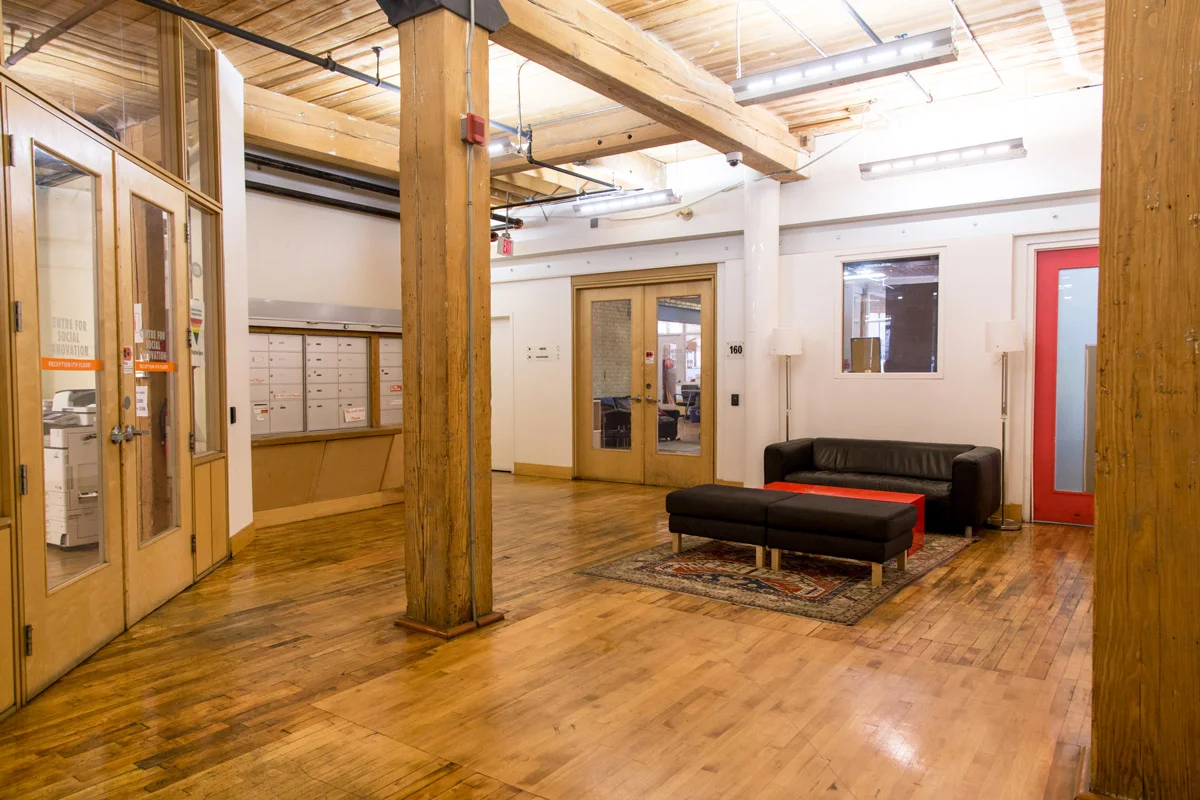
The Robertson Building is a restored warehouse in downtown Toronto located at 215 Spadina Ave. and is owned and operated by Urbanspace Property Group. The building is home to a cluster of community businesses, social entrepreneurs, and non-profit organizations.
Co-founded by Urbanspace, the Centre for Social Innovation occupies over 20,000 square feet on the first and fourth floors of the building. CSI provides shared workspace to over 170 nonprofits, social enterprises, artists, activists, and social entrepreneurs. Together, the centre's members are working to address the social, cultural, environmental, and economic challenges of we face today.
You can learn about upcoming tours by checking out the centre's Event Listing
Urbanspace Property Group was the recipient of a Green Toronto Award for green roofs at 401 Richmond St. W. and 215 Spadina Ave. in 2008.
Urbanspace Property Group and the Centre for Social Innovation were the recipients of a Bicycle Friendly Business Award in 2007.
Urbanspace Property Group owns and operates two heritage buildings in downtown Toronto. We have been running 401 Richmond Street West for over a decade, and the Robertson Building at 215 Spadina Avenue since 2002.
As a mission-driven developer Urbanspace Property Group's initiatives are directed toward the preservation and restoration of historic and architecturally significant spaces with the goal of adaptively reusing these buildings to provide commercial opportunities for the creative sector. Urbanspace also incorporates sustainable building efforts and a commitment to environmentally sound practices in the restoration, operation, and maintenance of all its properties. Our buildings provide space for the arts and social innovation communities and foster the development of an inspiring integration of commerce, culture, and community.
HISTORY
The Robertson Building was built for the James Robertson Company. It was constructed from 1911-1913 by Denison and Stephenson Architects, described by Toronto architectural historian John Blumenson as "good Edwardian architects." Prior to locating on Spadina at the address 207-219, the JAS Robertson Company operated from headquarters on King Street West. Advertisements
from 1898-99 found in the journal, Canadian Architect and Builder, were for fixtures that were manufactured by others and distributed by Robertson. Once the company moved to its Spadina location they were also manufacturing plumbing fittings and fixtures, featured in their substantial catalogues, and had opened a "sanitary exhibition" room. It would appear that the James Robertson Company was famous for its Spadina showroom, as an announcement from 1913 invites the community to come and "inspect the largest display of Plumbing and Sanitary Fixtures in the Dominion of Canada."
ARCHITECTURE
This five-storey 100,000 square foot building was purchased by Urbanspace Property Group in 2002 and two years was spent restoring and renovating the building. The perimeter walls are constructed of solid brick and the interior support structures are exposed Douglas fir post and beams. Ceiling heights between floors are twelve feet in height or more. Innovative green elements have also been included in the renovation of the building.
GREEN BUILDING
Green elements are a striking part of the eco-restorative* design of the Robertson Building. Urbanspace has shown leadership both locally and nationally by supporting green projects that provide environmental and health benefits to private and public interests. In March 2004, a 250 square foot living-breathing plant wall (bio-wall) was installed in the lobby of the Robertson building. The bio-wall was designed by Air Quality Solutions Ltd. and is composed of several varieties of native and exotic green and flowering plants. The plant species were selected for their ability to reduce indoor air contaminants generated from common causes of building off-gassing and from the steady flow of traffic on Spadina Avenue.
In June 2004, a 4,000 square foot, extensive green roof was installed over half of the Robertson roof. The green roof was designed and installed by Gardens in the Sky. The green roof is supported by five inches of organic, light-weight planting media and a host of native plant species that are thriving in this elevated ecosystem. To complement the green roof, a greenhouse and cedar viewing deck were installed so that tenants and special guests can enjoy a spectacular skyline view of the city as well as proximity to typical green roof biodiversity in this environment. The extensive green roof provides several other important environmental benefits to Toronto including: a habitat for birds, insects and other plant species; a micro-climate that reduces urban heat island effect; the retention of storm water when it rains preventing sewer overflow into Lake Ontario; the reduction of air pollutants by trapping and degrading contaminants; and protection of the roof membrane from harsh temperature changes giving greater longevity to a conventional roof.
*eco-restoration refers to activites that replace, rejuvenate or rebuild the natural ecology that may have existed before a building expropriated the natural elements. Hence, green elements like biowalls and green roofs are eco-restorative.